Sunday, April 23, 2006

7 days

The embryo is along the bottom part of the egg at the moment when this was taken:


A QuickTime movie showing the embryo moving within the egg (they are quite lively!)

poultry on television

Be sure to watch "Fowl Play" on Animal Planet tonight at 8pm (it reruns a few other times too). Unfortunately I don't have cable so I won't be watching it but hopefully will be able to acquire a copy a bit later in the week. Should be interesting. I will know people in it. My birds might be in it. My hand might be in it (I was filmed while grooming a bird at the show in Stockton).

Saturday, April 22, 2006

6 days

Day 6 of incubation, blood vessels becoming more obvious, entire egg except air cell getting darker:

An embryo that died within the first week of incubation, showing the characteristic "blood ring":

An infertile egg. As the egg ages, the albumen (egg white) thins out and the yolk comes closer to the shell. That's that dark area you see in this egg. In a fresh egg, the "yolk shadow" isn't nearly this obvious:

An infertile egg with a very speckled shell, I'm showing you this just because it's interesting:

An egg that is hatching!:

There were three chicks hatched this morning, they should be done by tomorrow afternoon. I shot some QuickTime video of one while it hatched (through the hatcher door, through the wire, with a flashlight and my camera). The quality isn't good and they are huge files but I can post them here if anyone wants to see them.. let me know. I'd need to find a way to shrink them down, maybe turn them into zip files or something.

Friday, April 21, 2006

5 days

Normally I only candle eggs once a week, every Saturday or Sunday, so this is kind of new to me also to be looking at one every day. So if you're thinking "gosh, it was more obvious a few days ago" I'd have to agree in some ways. The blood vessels are now little threads all over around the air cell instead of just in one concentrated area, but as you can see they don't photograph particularly well. What I am trying to show in this photo is that egg takes on a two-tone appearance, with the pointy end getting noticeably darker.

It's been years since I took an embryology class so I can't explain WHY things look the way they do, and I'm not going to break these eggs open to get a better look. If you search the web for pics you can certainly find a lot, if that interests you.

When I go through all the eggs this weekend I will photograph an infertile egg and a dead egg (there are sure to be both) so you can see the difference.

Why is the egg reddish-orange? They just look that way when you shine a light through them! The infertiles are often more of a yellowish orange. Don't ask me why. :-) "That's just how it is."

Chicks

This is mostly for my own records that I'm writing this (will I do it every week? Hard to say...) but I can think of at least three readers who will find it interesting. I cleaned brooders this morning and moved the first batch of chicks out to the storage room, and counted them all while I was at it. So, these are the breeding pens and what they produced this time around (the first letter/number combo refers to coop #):

T (Brassy Male & Blue Brassy Male X Brassy, Blue Brassy, BBB Splash females): 1 Splash, 3 Blue Brassy, 1 ??? (resembles T6 Silver chick, mismarked??? I'll know when it's older)

O2 (BBRed X BBRed): 5 BBRed

B (BBRed male X Brown Red females): 8 BBRed, 5 Brown Red

T1 (BBRed male X F1 Crele female): 5 BBRed, 2 Crele (is this sex-linked?)

T2 (F1 Crele male X BBRed females): 6 BBRed, 2 Crele (sex-linked?)

T3 (F1 Cuckoo male X Black female): 1 Cuckoo, 2 Brassy Back (?), 1 ??? (chick color is like Brassy Back with white spot on head, feathers are Cuckoo) (sex-linked?)

T4 (Black male X F1 Cuckoo females): 9 Cuckoo, 3 Black (sex-linked?)

T5 (Black male X F1 Cuckoo females): 6 Cuckoo, 9 Black (sex-linked?)

T6 (Silver Duckwing OE male X Black female): 1 ??? (chick color like BBRed but lighter, feather color appears stippled gray, so perhaps is Silver Duckwing, I would have expected Birchen-ish)

T7 (Brown Red male X BBRed females): 3 BBRed, 4 Brown Red

N2 (Black X Black): 1 Black

N3 (Black X Black): 3 Black

N4 (Black X Black): 1 Black, 3 Brassy Back (what??)

N5 (Black X Black): 1 Black

Thursday, April 20, 2006

4 days

I know, it's hard to see if you aren't used to looking at these things, but squint your eyes and sit back a bit. I have the egg at a different angle today, so you are also seeing a bit of writing on the shell, and the pale area there against the light is the air cell, which will continue to expand.

Wednesday, April 19, 2006

Chick-watching

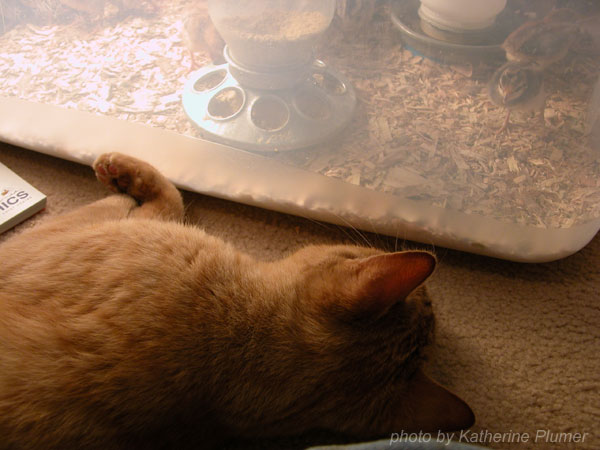
Olin and I were doing some chick-watching this evening. This is the first year I've used see-through brooders, so he's enthralled. He's a perfect gentleman about sitting down and watching them, but I wouldn't trust him alone with them for even half a second! Yes, he is licking his lips in that first pic!


3 days

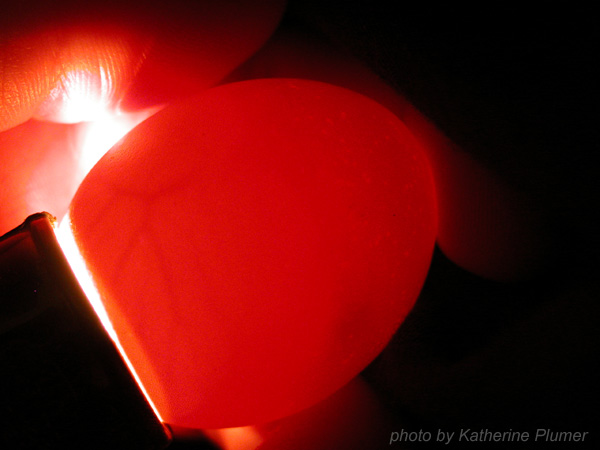
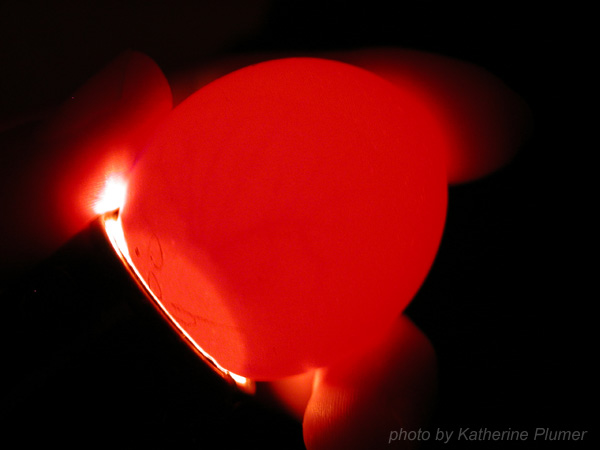
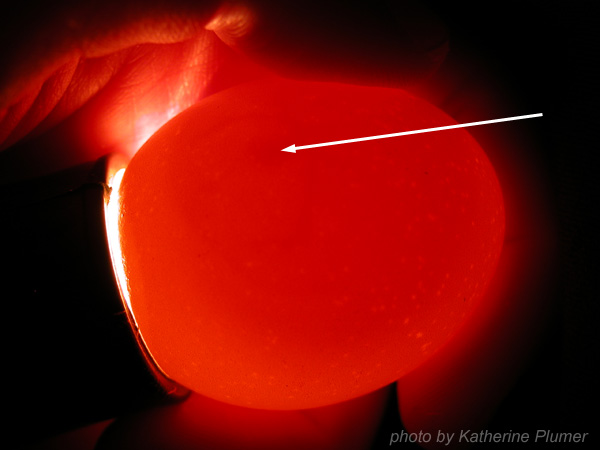
Good news! The chosen egg is indeed fertile! It's easier to see this in person than it is in a photograph, but you can now see a dark spot (the embryo) surrounded by a system of blood vessels (a circle shape at this point, it'll expand as the embryo keeps developing. If you can't see it at all, the second pic has an arrow pointing at the embryo.


Tuesday, April 18, 2006

2 days

I had this nifty idea of something I can post on here: the development of a chick in the egg! So I will post a photo every day (or almost every day) to show the embryonic development. Note: no chickens will be harmed in the making of this series! I am going to take pictures while "candling" the eggs, which means shining a light through them so that the insides are visible.

So I set eggs Sunday afternoon, and here is a picture on day 2 of development:

If you are thinking it looks like absolutely nothing, you are right. This is indistinguishable (without cracking it open) from a non-incubated egg, because the embryo is not developed enough right now to be visible by candling.

The catch is, I don't know whether this egg is fertile or not. Probably, given which breeding pen it came from (it's a Cuckoo), but I won't know for sure til later in the week. If it's infertile I will switch to a different egg! They all look the same right now. :-)

Sunday, April 16, 2006

Easter Chickies!

Despite having gotten a late start on hatching this season, there is always something sort of neat about having the first hatch on Easter. And despite the fact that I have hatched thousands of chicks over the years, nothing diminishes the excitement of the first hatch of the season. They started pipping through the shells Friday afternoon. A few had hatched by Saturday morning, and then it was like popcorn til this afternoon. This is a HUGE hatch. It's not that the hatch rate was all *that* phenomenal (though I must say for my birds it was pretty darn good!) but I set a whole lot of eggs because I'd collected them for two weeks (usually I just collect for one week, but I didn't want them to hatch last weekend since I was not here!). So although they are sort of impossible to count, there are roughly 90 chicks. Now considering I only usually hatch about 250 per year, that's really kind of amazing. I have never had that many of all one age group before, so it will be a bit of a struggle to fit them into the brooders (usually it's more like 20-30 per week!) But, I'll figure it out somehow! It'll still take a while to hatch enough Blacks, but I can definitely stop collecting eggs from the Cuckoos and Creles. Holy moley I have Cuckoos coming out my ears! They had a great hatch rate, so with three more weeks of them still in the incubator, I ought to have way more than enough of that color.

The view when I opened the hatcher door (the door is see-through but it doesn't photograph well with the door closed!) But it was time to take the chicks out, so I took a pic:

Tray #1:

Tray #2:

There were still a couple of stragglers in the incubator at this point, but that's essentially all the chicks in the brooder box that they will quickly outgrow...:

Awww, chickies!:

It amazes me how fast they find the food and water:
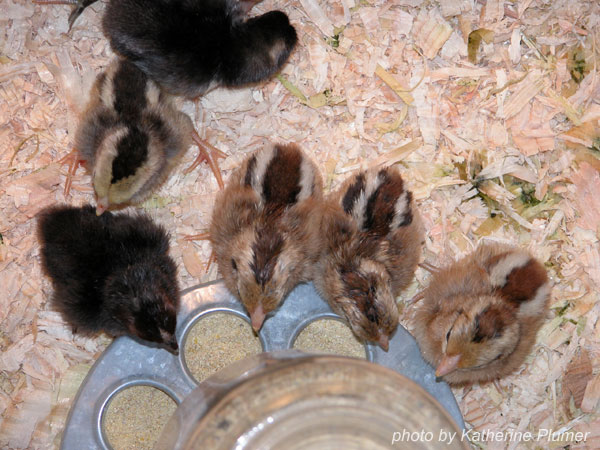
I can't resist going into the room to watch them from time to time. They are pretty funny. They are the perfect age right now, less than a day old.. They aren't afraid of me yet (by tomorrow they probably will be). Like all babies, they spend most of their time sleeping, and the rest of it eating and pooping... They are a mass of fuzzy warm wonderfulness. And soon they will be wild little bratty things, and then in a few months they bloom into beautiful show birds.

There are a lot of "life lessons" with the birds, I guess you could say. You deal with the whole life cycle, and sometimes the hardest part of that is when the life cycle is very short. Of all the eggs that go into the incubator, you know that some will not hatch, either because they aren't fertile to begin with, or because they die along the way. Sometimes that's environmental (incubator temperature, etc), but mostly it's genetic. It's sad when they develop all the way but don't hatch. Or sometimes they can get themselves almost all the way out of egg but can't finish the job. I'm a softie, I help the stragglers, but often they don't live anyhow. Of all the chicks that hatch, you know that not all will live. It's just part of life. I don't want to say that you "get used to it" as that sounds a bit cold-hearted, but you come to accept it.

There were some interesting things I noticed in this hatch.. The Brassies and Blue Brassies had an unusually high embryonic mortality rate. I don't recall seeing that in past years, so I'll have to keep on eye on that. I had thought the Crele X BBRed chicks were all turning out BBRed, but some of them have a white spot on the back of the head... so... hmm, perhaps they are Creles? Who knows. Pen #4 of the Black birds threw 3/5 Brassy Back this time. Ack! Brassy Back supposedly originated as a sport of from Black. I usually get two or three a year, total, from the Blacks, but three out of five in one batch?!!? I may need to switch males.. If they are good Brassy color they should have phenomenal type (they are, after all, 100% Black in terms of genetics), but really I would rather hatch out Blacks! Hmm. And the Cuckoos (Cuckoo male x Black female) are throwing Brassies again too.

I guess that's why I named it "Random Rosecombs." ;-)